An Australian food history fantasy

23 Nov

In 1770, Captain Cook claimed the east coast of Australia for England. In 1788, the First Fleet came with everything they planned to eat and grow. After an initial period of near starvation, where the white settlers ignored Aboriginal methods of gathering food, the colony eventually got off the ground. The diet of these people, for the next 170 years or so, was pretty much a meat-rich version of what they ate in England. One of the chief concerns of their diet was not taste but “softness or ease of chewing”. I guess that explains all those overcooked vegetables then.
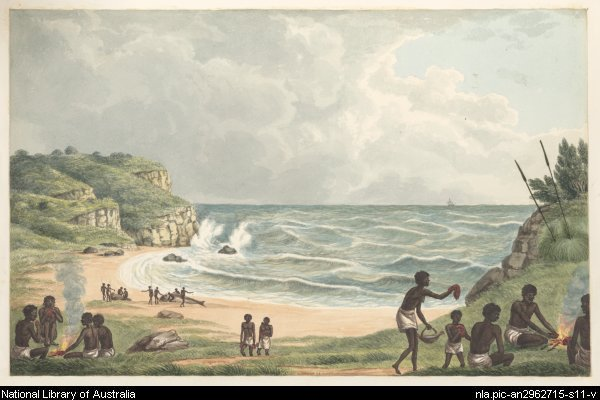
Painting of Aborigines eating and cooking

Joseph Lycett’s 19th century painting Aborigines cooking and eating beached whales, Newcastle, New South Wales. National Library of Australia – http://nla.gov.au/nla.pic-an2962715-s11

Now, imagine if, the Spanish, Portuguese and Dutch, who are all thought to at least have sighted Australia in the 17th century, had decided to drop anchor and establish colonies. Say the Spanish had claimed the area near Adelaide, the Dutch taken far north Queensland and the Portuguese south-east Western Australia. Imagine too, that these European settlers hadn’t written off Aborigines as people who “barely existed”, and learnt a trick or two from their traditional foodways. While we’re imagining, let’s pretend the Aborigines had used their crops to trade with these new settlers for things like cooking implements, chocolate, vanilla and other spices.

Would all of this have resulted in the development of distinct regional cuisines, a mash-up of  colonial and indigenous ingredients and cooking methods? Would we now have a canon of dishes that included paella studded with kangaroo paws and witchetty grubs, poffertjes flavoured with lemon myrtle and quandong custard tarts? Would our national dish be wombat cooked in an underground oven, covered in a chocolate sauce?

In We are what we eat: ethnic food and the making of Americans, Donna Gabaccia explains that the arrival of various colonial powers settling in different areas of the States, combining  their own foodways with those of local indigenous populations, resulted in creole cuisines. Trade and curiosity, amongst other factors, helped these creole cuisines to form and, over time, they became distinct regional cuisines. It’s a fascinating read and prompts one to imagine how food in Australia could’ve been really quite different.

But the Spanish, Dutch and Portuguese didn’t claim any part of Australia and  while the Aborigines did have an agricultural tradition, as Bruce Pascoe taught us, there was no significant trade. As a result, we don’t have any regional cuisines – with the possible exception of the German-influenced food of the Barossa Valley – which means, according to anthropologist Sidney Mintz, we don’t have a cuisine at all.

What we do have, however, is a way of eating that combines great product (tomatoes largely excepted), a food-interested population and the influences of cuisines and people from all over the world. It might’ve taken more than 170 years to get to that point, but thank god we did get there. Which is probably just as well, because chocolate-covered wombat doesn’t sound like anything I would want to eat…

Bibliography:

  • Bacon, Jenny. “A brief history of immigration to Australia,” In Tucker in Australia, edited by Beverley Wood. Melbourne: Hill of Content, 1977, 98-102.
  • Cahn, Audrey. “Australians in the early Twentieth Century,” In Tucker in Australia, edited by Beverley Wood. Melbourne: Hill of Content, 1977, 53-63.
  • Davey, Lois . Margaret MacPherson and F. W. Clements, “The Hungry Years: 1788-1792,” In Tucker in Australia, edited by Beverley Wood. Melbourne: Hill of Content, 1977, 24-46.
  • Gabaccia, Donna R. We are what we eat: ethnic food and the making of Americans. Cambridge, Mass.: Harvard University Press, 1998.
  • Mintz, Sidney W. Tasting food, tasting freedom: excursions into eating, culture, and the past. Boston: Beacon Press, 1996.
  • Shelley, Cheryl. “The original Australians – Aboriginals in the Northern Territory,” In Tucker in Australia, edited by Beverley Wood. Melbourne: Hill of Content, 1977, 19-23.

Crimes against pizza – 3. Banana pizza

14 Nov

Someone, maybe this guy, once put pineapple on a pizza and, for some strange reason, it stuck. The Hawaiian is a much derided but long-established pizza tradition. At the Australian Women’s Weekly, some bright spark thought they might have the same success with bananas, and so they put salty fish, savoury tomatoes, stringy cheese and sweet bananas together on a buttery bread base. It did not stick, it just stunk, and, as a result, is our third documented case in the crimes against pizza series…

Banana pizza

Crime number 3: Banana Pizza

Accomplice: Australian Women’s Weekly, in a special Banana Cook Book, which may, or may not, have been advertorial.

Date of crime: Wednesday 25 February 1970

Modus Operandi:

Yeast Dough

1 ½ cups plain flour
pinch salt
½ oz. compressed yeast
½ teaspoon sugar
¼ cup milk
1 beaten egg
1 oz. butter or substitute

Filling

½lb. tomatoes
1 small can anchovy fillets
little milk
1 dessertspoon oil
½ teaspoon oregano
1 small onion
¼ cup tomato paste
4 oz. grated gruyere cheese
2 medium bananas

Yeast Dough: Sift flour and salt into bowl, add sugar. Dissolve crumbled yeast in warmed milk, add beaten egg. Stir yeast mixture into dry ingredients, blend well. Cream butter and work it into the dough. Cover bowl and stand in warm place 40 minutes or until doubled in bulk. Press dough into 9in. pie plate or on to base of 9 in. sandwich tin.

Filling: Peel and slice tomatoes. Soak anchovy fillets in a little milk ½ hour; drain. Heat oil in frying pan, add chopped onion and oregano fry 2 to 3 minutes. Place tomato slices in centre of dough. Arrange peeled and sliced bananas in a ring round edge. Spread tomato paste over them. Sprinkle with fried onion and grated cheese, arrange anchovy fillets on top. Bake in hot oven 30 minutes. Serves 4.

Evidence: See image above. Plus this quote:

Banana Pizza, a new variation of this popular dish, combines the good flavor of bananas with cheese, tomatoes, and anchovy.

Verdict: You can make the presentation as pretty as you like, but once you’ve spread bananas with tomato paste you’ve gone rogue. The banana pizza is guilty of badly imitating an already dubious trend – that of combining fruit with savoury ingredients, as well as claiming such a concoction to be edible.

Sentence: Rehabilitation. Get rid of the fish, cheese and tomato paste, replace with nutella, chuck bananas on top of it and call it a dessert pizza. Not traditional, but, unlike the previous incarnation, actually pretty delicious.

See more Crimes against pizza

Bibliography:

  • “Banana Cook Book.” The Australian Women’s Weekly, 25 February 1970, 127.

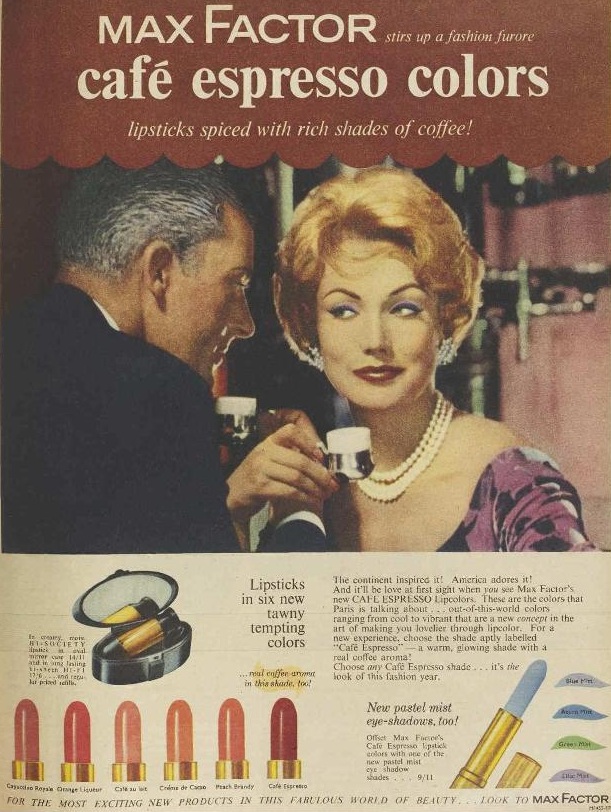
Why drink espresso when you can wear it?

8 Nov

With “real coffee aroma” in every lipstick, we can’t understand why Max Factor’s Cafe Espresso Lipcolor range is no longer around…

Max Factor Cafe Espresso Lipstick

Bibliography:

“Cafe Espresso Colors.” Australian Women’s Weekly, 13 April 1960, p 27. 

Crimes against pizza – 2. Copha Pizza

4 Nov

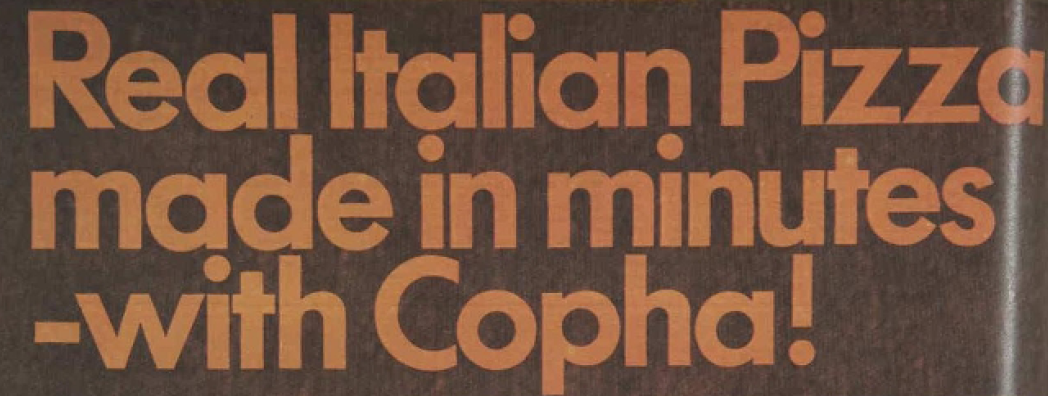
I don’t know about you but when I see the words “Real Italian Pizza” I don’t expect them to be followed by “made in minutes – with Copha!”

Real Italian Pizza made with Copha

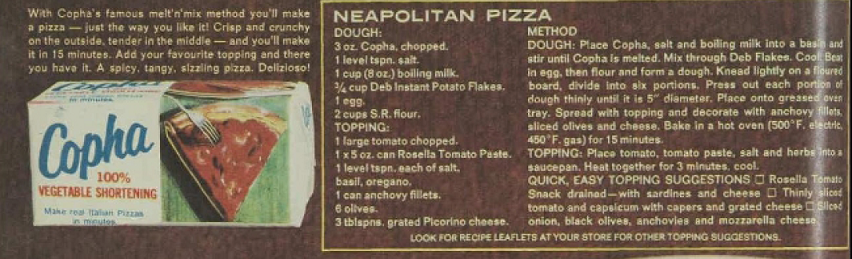
It’s not that I object to that greasy white slab of 100% fat. Copha does have a place in society – and that’s hardening the young ‘uns arteries in party treats like chocolate crackles and white Christmas. It certainly should not be in pizza dough, especially not with Deb Instant Potato Flakes and 1 cup of boiling milk. Seriously, I couldn’t make this stuff up. It’s not just wrong, it’s, well, criminal:

Crime number 2: Copha Pizza

Accomplice: Australian Women’s Weekly (for all the good AWW has done for Australian food, they’ve certainly done their fair share of bad…)

Date of crime: Wednesday 24th April 1968

Motive: With 97 – 100% saturated fat, surely it’s to make more of us have heart attacks. And sell more copha. And sell more Deb Instant Potato Flakes.

Modus Operandi:

Neapolitan Pizza

DOUGH:
3 oz. Copha, chopped
1 level tspn. salt
1 cup (8 oz.) boiling milk
¾ cup Deb Instant Potato Flakes
1 egg
2 cups S.R flour
TOPPING:
1 large tomato chopped
1 x 5 oz. can Rosella Tomato Paste
1 level tspn. each of salt, basil, oregano
1 can anchovy fillets
6 olives
3 tblspns grated Picorino (sic) cheese

METHOD

DOUGH: Place Copha, salt and boiling milk into a basin and stir until Copha is melted. Mix through Deb Flakes. Cool. Beat in egg, then flour and form a dough. Knead lightly on a floured board, divide into six portions. Press out each portion of dough thinly until it is 5” diameter. Place onto greased oven tray. Spread with topping and decorate with anchovy fillets, sliced olives and cheese. Bake in a hot oven (500°F, electric, 450°F gas) for 15 minutes.

TOPPING: Place tomato, tomato paste, salt and herbs into a saucepan. Heat together for 3 minutes, cool.

Evidence: Instructions for Copha Pizza

Pizza made with Copha

Verdict: Guilty of six counts of perverting the integrity of pizza – use of Copha, use of Instant mashed potatoes, use of the words “Real Italian Pizza”, calling the recipe “Neapolitan pizza”, incorrect spelling of pecorino (picorino) and claiming the dish to be “delizioso”.

Sentence: Chocolate crackles should not have to pay the price for this crime so the sentence is suspended on condition of never seeing Copha claiming a place in a regional Italian recipe ever again. Or any recipe outside of chocolate crackles and white Christmas, for that matter.

See more Crimes against pizza

Bibliography:

  • “Real Italian Pizza made in minutes – with Copha!” Australian Women’s Weekly,  24th April 1968, p 64.

Crimes against pizza – 1. Vita Brits Pizza

2 Nov
Vita Brits Pizza

Vita Brits Pizza - A criminal act?

For too long now, the pizza – that most humble of Neapolitan inventions – has been the target of overzealous recipe writers, “creative” chefs and idiot advertising types who think it is best made with canned dough and served with teriyaki sauce, chicken, pineapple, and both fetta and cheddar cheese.

While there have been many moves to defend the pizza, mostly from Italians concerned that their culinary heritage is being destroyed, little has been done to name and shame the worst perpetrators of these horrifying and indecent acts.

Over the next few weeks, this special Lamingtons & Lasagna investigation promises to open cold cases where the rights of the pizza were trampled over, its victim impact statement never heard. Until now, that is.

While Lamingtons & Lasagna does not advocate a return to culinary luddism – where what was authentic was sometimes even deadly – the “pizzas” in this series have jumped the shark, or, as the kids these days might say, nuked the fridge, from imaginative interpretations to crimes against cuisine.

So, without further ado:

Crime number 1: Vita Brits Pizza

Accomplice: Australian Women’s Weekly

Date of crime: Wednesday 15 October 1958

Motive: There’s only so much money a company can make selling breakfast food for breakfast. But if they give you “delicious, new round-the-clock recipes” which mean you can enjoy “different and delicious luncheon or supper treats”, then they can make a lot more money.

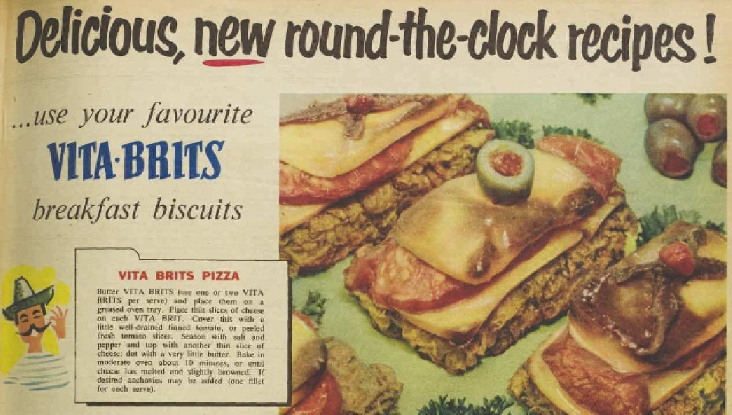
Modus Operandi: “Butter VITA BRITS (use one or two VITA BRITS per serve) and place them on a greased oven tray. Place thin slices of cheese on each VITA BRIT. Cover this with a little well-drained tinned tomato, or peeled fresh tomato slices. Season with salt and pepper and top with another thin slice of cheese; dot with a very little butter. Bake in moderate oven about 10 minutes or until cheese has melted and slightly browned. If desired anchovies may be added (one fillet for each serve).”

Evidence: Vita Brits Pizza

Verdict: Guilty

Sentence: Never eat Vita Brits again (which is fine, because I prefer Weet-Bix anyway).

See more Crimes against pizza

Bibliography:

  • “Delicious, new round the clock recipes.” The Australian Women’s Weekly, 15 October 1958, 75.

Helmut Newton’s perfect cheese photography

24 Oct

When I think of photographer Helmut Newton I think of fashion. More specifically, I think nudie, rudie Vogue-like fashion. Which is cool, if you like that kind of thing, but I prefer food, in particular cheese.

So I did not expect the man responsible for (potentially not workplace-friendly)  this and this to be taking photos of this:

Perfect Cheese Co Parmigiano

And yet Berlin-born Newton, who served in the Australian army and became a citizen of our fine country in 1946, is credited as the photographer of the 1955/6 Perfect Cheese Co. Silver Anniversary souvenir booklet:

Perfect Cheese Co Souvenir Booklet

You might know the Perfect Cheese Co. better as Perfect Italiano which is what it became in 1996. But, back in the 30s, way before it was part of multi-national Fonterra, the Perfect Cheese Co. was a small family-run operation started by one Natale P Italiano and his lovely wife Maria. Here they are, photographed by Newton:

Natale and Maria Italiano, Perfect Cheese CoBy the time this booklet came out, the Perfect Cheese Co. was known throughout Australia and was doing very well for itself – having increased production from 2,000 pounds in 1930 to 900,000 pounds in 1954. According to Randazzo and Cigler, the company is also credited with pioneering sheep-milk production and producing the first pecorino cheese in the country.

The souvenir booklet – which you’ll find at the State Library of Victoria  – is well worth seeking out. In both English and Italian it shows just how close the Italianos were to the Italian migrant community they primarily, but not exclusively, served. Who else would have a Catholic priest write the dedication to what is essentially a marketing exercise?

At the same time, they weren’t limited by the dairying traditions they knew from the old country. Amongst the mozzarella and the ricotta, you’ll also find fetta in brine, kasseri and grated cheese in little packets. More evidence to support the fact that success in the food industry for Italians in Australia came from adapting to a new market, not exporting food traditions wholesale.

As for Helmut Newton, who knew you could go from fetta to fashion (or pecorino to near-porn) in the span of a single lifetime…

Bibliography

  • Helmut Newton Foundation . “Biography.” Helmut Newton Foundation. <http://www.helmut-newton.com/helmut_newton/biography/> (24th October 2011).
  • Perfect Cheese Co. Perfect Cheese Co. – Silver Anniversary 1956, South Melbourne, Vic. : Freelance Press,1955.
  • Randazzo, Nino & Cigler, Michael. The Italians in Australia, Melbourne : AE Press, 1987. 

Thoroughly modern macaroni

6 Oct

Just when you think you know how 19th Century Australians cooked their pasta, along comes a recipe that changes everything.

Before we go on, however, you have to know there was no such thing as pasta in the 1800s – it was called macaroni. And it was most commonly cooked in a sweet pudding , much like a rice pudding, in a bake of some sort, like macaroni cheese, or as an accompaniment or garnish to different meats  (ox tongue garnished with macaroni anyone?).

There were, of course, exceptions, mostly revolting-sounding ones which involved brown gravy and batter, but none are as exceptional and out of place as the recipe below:

Maccaroni Dressed with Oil.

Take two cloves of garlic, slice them very finely crosswise, and set them to boil in a gill of fine olive oil, adding during the process two or three anchovies, well washed and boned, and cut in small pieces, and a dozen or more olives, cut in two and stoned.  When the slices of garlic assume a golden color, pour the whole over 1/2lb of boiled string maccaroni (Vermicelli or Spaghetti) well drained; mix well, and serve.

It comes from Australian Town and Country Journal in 1890 and, culinarily for its time, it’s a freak.

Not only does it contain garlic and olive oil – both at least a good seventy years away from real acceptance in the mainstream Australian pantry; it doesn’t contain any kind of protein – unless you count anchovies – which I don’t;  and it mentions spaghetti – which, while not unheard of in this period, is rare. The recipe is not prefaced with it being Italian, or foreign or unusual in anyway. It’s just a normal recipe for normal housewives, unlike any others before it, and a good way ahead of any others that follow it.

Unfortunately, there’s no author given for the recipe and that is a real shame, because they should be congratulated for their foresight…  of course, this could mean the recipe was plagiarised, in which case I take the congratulations back…

Bibliography

“Maccaroni Dressed with Oil,” Australian Town and Country Journal,  26 April 1890, 34.

A recipe for ravioli…

26 Sep

For kicks these days, I spend a lot of time looking for Italian recipes in Australian cookbooks. The one below comes from the 1961 edition of the P.W.M.U. Cookery Book. It left me asking one question. Read it, and see if you can figure out what that question was:

Ravioli

1lb. rissole steak, 1 cup diced celery, 1 chopped onion, 1 dessertspoon curry powder.

Heat a dessertspoon of oil and fry onion. Add curry powder, salt and pepper. Add steak and brown a little. Add 8 oz. tin tomato soup, celery and flavourings. Cook 1 cup spaghetti and add. Serve sprinkled with grated cheese.

The question, dear readers, is why? Why on earth is this recipe titled ‘Ravioli’? If ravioli, in its broadest definition, can be described as a stuffed pasta, this recipe is just, well, stuffed…

Bibliography

  • Jenkins, Gwen, Hanna, Betty, McMillan, Muriel and Presbyterian Women’s Missionary Union of Victoria P.W.M.U. cookery book (Rev., enl., redesigned and completely reset ed). Melbourne: Cheshire, 1961.

What Elizabeth David told us Aussies…

14 Sep

In 1953, the great Elizabeth David – she who introduced the wonders of Italian food to the heavily fish and chip-dependent Brits  –  had some advice for Australians.

In a fabulously named article  – “A new ‘Mrs Beeton,’ but she likes garlic” – David sings the praises of snails smothered in butter made with, well, garlic,  talks about the upcoming publication of her book Italian Food and shares some Australia-specific thoughts with the Courier-Mail correspondent, who, diligently, went looking for the local angle, no doubt to please his editor back in Brisbane. Anyway, here’s what she had to say about us:

  1.  She is flattered by the volume of fan mail from Australians but is “stumped” by the questions that come with it, often about substitutions for different ingredients. I can imagine those  letters …“Dear Mrs David, Can I substitute witchetty grubs for snails…”
  2. “She thinks Australians are on the right track in adopting minestrone from Italian migrants as almost an Australian national dish.” News to me that we almost did this, and had I been the Courier-Mail correspondent I would’ve asked where she got her national dish information from. A Gallup poll perhaps? Roy Morgan?
  3. “Mrs. David hopes the Australian housewife is using plenty of wine in her cooking. In a major wine producing country it would be a sin to exclude it from the kitchen, she says.” We might have been a wine producing country but in 1953 we were still serious wowsers, with 6 o’clock closing enforced in most pubs around the country and wine drinkers looked on with suspicion.
  4. “She says the French learned cooking from the Italians and that everybody else should do likewise.” And that, dear readers, is something I can’t argue with at all…

Bibliography

  • “A new “Mrs Beeton,” but she likes garlic,” The Courier-Mail,  26 October 1953, 8.

Cooking with my nonna – carciofi

24 Aug
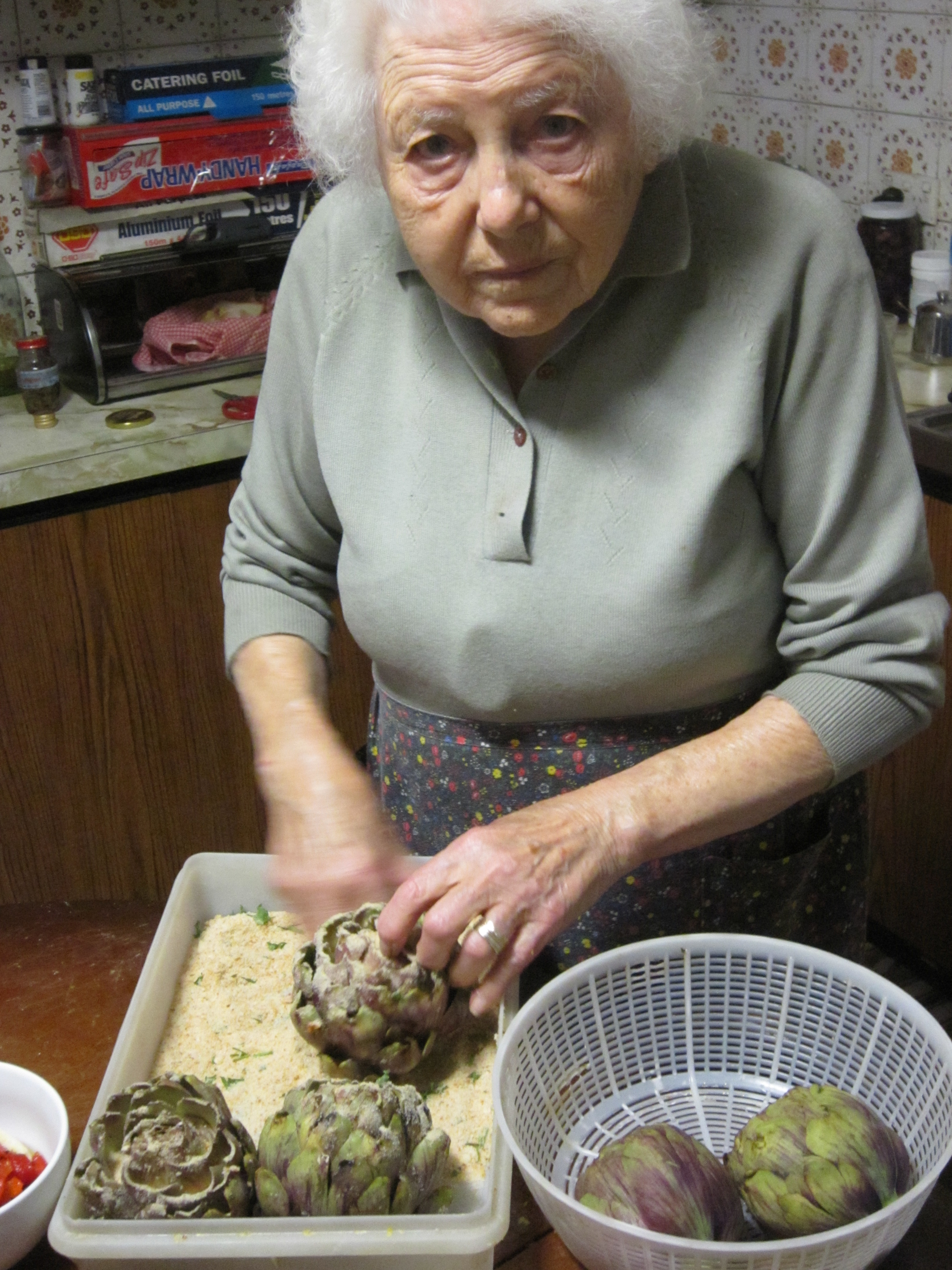
Nonna makes carciofi

Nobody makes carciofi like this woman, my grandmother.

When I tell nonna that most artichoke recipes call for a lot of the leaves to be cut off, she looks disgusted.

“It’s waste. Waste! People have too much money! They didn’t live through the war. We ate potato peelings. The peelings of the potatoes!”

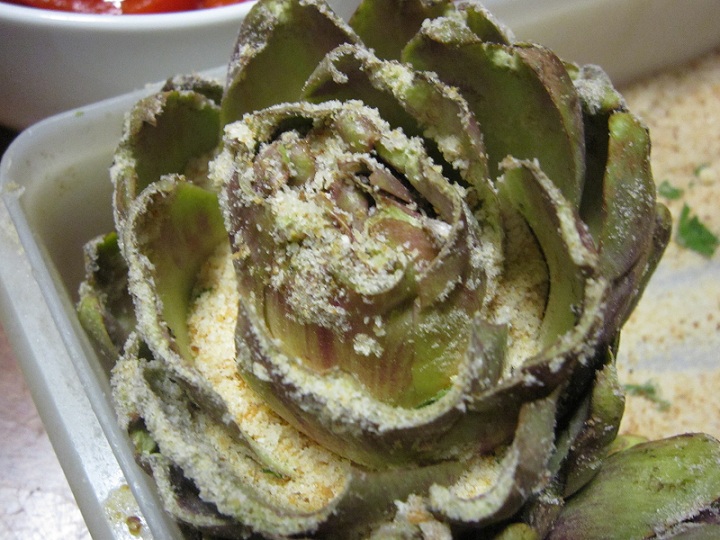
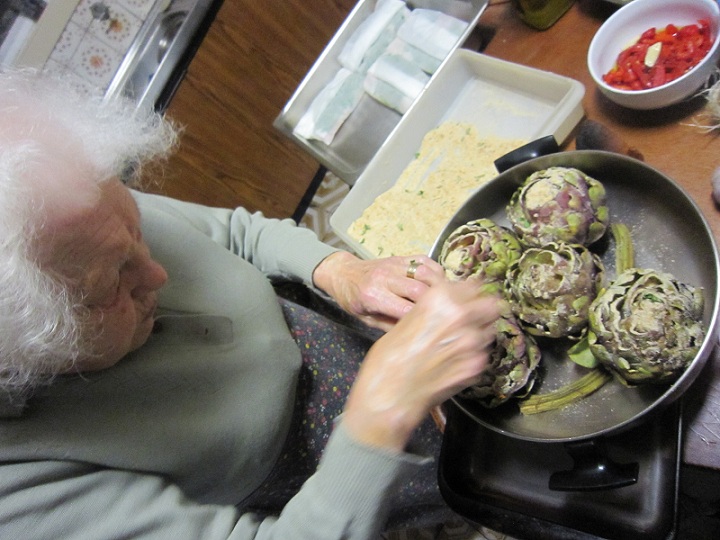
Nonna is showing me how to make artichokes – carciofi –  the way she has always made them, with breadcrumbs, parsley, garlic and not much else. Nothing, well nearly nothing, gets cut off and thrown away.

“Just the top of the leaves where they are really hard. And the stalks. Though you can cook them too.  Everything else is good. What do you think? We’re Americani! No.”

As I ponder nonna’s obsession with Americans and wealth – not a day goes by where she doesn’t mention their wasteful, extravagant ways – she shows me how to open up the artichoke with my hands and sprinkle a mix of breadcrumbs, parsley, salt, pepper and parmesan into each one.

As always, the question of quantity comes up. How much breadcrumbs, parsley, salt, pepper and parmesan?

“Tania, you always ask this question. You need as much as the artichoke needs. Use your eyes in your head to see!”

“But nonna, I can’t write that in the recipe, people won’t understand. And then they’ll ring me and abuse me for giving them a recipe that doesn’t work.”

“Pah! Just write ‘It needs as much as it needs’. They will understand. What are they? Stupid! Basta with this question! No more ‘how much’, ‘how much’…”

Nonna stuffing artichokes

Stuffed artichoke

Nonna moves the stuffed artichokes into a pan. She apologises.

“Sorry, sorry, see there should be seven artichokes, because seven fit. Five is no good. Too much space.”

Nonna is a serial apologiser. It’s like her diabetes – a disease. She always does it in English too. It is never “mi dispiace” but always “sorry, sorry”.

I take a photo. Nonna isn’t happy with the five artichokes in the picture. She grabs two stalks and puts them in the empty spaces.

“Better… but if only I had seven. Sorry, sorry.”

Artichokes in the pan

Five artichokes in the pan

As browned fried garlic is poured over the carciofi and they are put on the stove with a little water to cook, I notice how much else nonna has made for dinner.

She has already prepared chicory and roasted red peppers, the fish is in the oven and broccoli soup is bubbling away.

She tells me she is going to put ravioli in the soup.  I gasp. My father will have (another) heart attack. Ravioli, in the world of Romano Cammarano, does not go in broccoli soup. It will be a controversial move on nonna’s part.

But she likes “fantasia”- imagination –  in cooking. And she will do whatever the “fantasia” tells her.  It’s telling her to put the ravioli in the soup. I warn her about Romano.  She shrugs and puts the ravioli in the soup.

Later, predictably, Romano Cammarano turns his considerable Roman nose up at the dish. But nonna has been true to the “fantasia”. That is what is important here.

Nonna pours garlic over artichokes

Artichokes with garlic oil

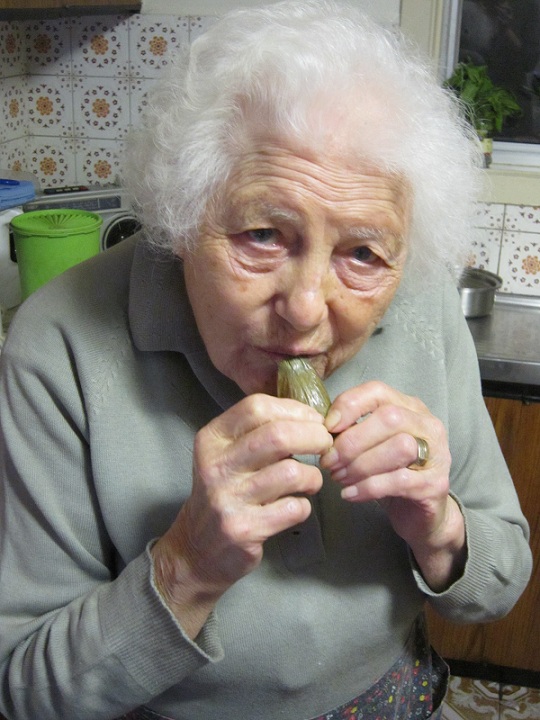
The carciofi are cooked when a leaf comes clean out of it and you can easily scrap away the breadcrumby, artichokey goodness at the bottom of each leaf with your teeth.  You do this over and over, making a pile of discarded leaves on your plate, till you get to the payoff for all your hard work – the heart.

Some unscrupulous members of your family might try to steal the heart. This is an offence and should be dealt with severely.

Nonna tests artichokes

Carciofi cooked like this might be the last bastion of true wogginess.

I notice funny looks from my colleagues when I eat them at my desk, piling up the waste paper basket with artichoke leaves. I guess I will never work at BHP.

Also, when non-Italians eat at nonnas, they never touch the carciofi. Pasta, wild greens, eggplants, sausages, salami, prosciutto? Yes, please, no problem at all. But carciofi? No, thank you, I’m very full, and the thought of all that teeth scrapping and greasy fingers is just too, well, woggy  I guess…

This, however, is not a problem. It just means there’s more carciofi for me.

Pile of artichoke leaves

Nonna’s carciofi

  • 5 artichokes, hard leaves at the top trimmed and stalks cut off
  • 2 cups of breadcrumbs, more or less
  • A handful of parsley, chopped
  • A handful of Parmesan, grated
  • Salt and pepper
  • 3 cloves of garlic, sliced
  • Olive oil
  1. Mix together the breadcrumbs, parsley, Parmesan and salt and pepper.
  2. Open up the leaves of the artichokes with your hands and sprinkle the breadcrumb mixture over them, making sure you get plenty between the leaves. Place the artichokes in a snug pan with high sides.
  3. In the meantime, fry the garlic in a considerable amount of olive oil till it browned. Pour the garlic oil over the artichokes.
  4. Put the pan over medium heat and pour in enough water to come half-way up the sides of the artichokes, add a pinch of salt, and half cover with a lid.
  5. Cook until a leaf comes away easily from the artichoke. It should take about 45 minutes. Or less. Or more. Don’t let the water dry out – add more if you need it. And remove the lid to dry them out if there’s too much water.