Italian or not, I heart Sirena tuna

18 Aug

Today I learnt something that probably everyone else in the entire world knows.

Sirena tuna is not and has never been Italian.

Its bright yellow and red tin, cute little fish and modest retro mermaid might all evoke 1950s Vespa-Lollobrigida Italy but the product is the invention of a canny migrant from the Veneto whose family is now worth  some $327 million, according to BRW’s rich list.
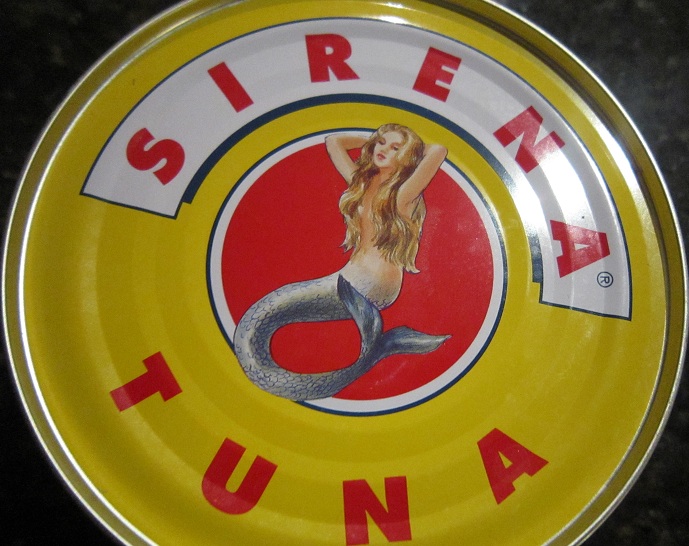
Can of Sirena Tuna

A true Italo-Australian: Sirena tuna, since 1956.

Carlo Valmorbida saw a gap in the market in 1950s Melbourne for tuna preserved in olive oil. Instead of importing it, he decided to service the increasing “continental” market by getting it made to his own Italian recipe. And so Sirena tuna was born.

Not imported from Italy like I thought, but made in Australia by Italians. Kind of like me.

According to a report by GJ Crough on the development of the Australian tuna industry (now there’s a thrilling read!), Sirena tuna was originally canned in Port Lincoln, from tuna fished off NSW. Later it came to be canned in Melbourne, which meant it was “located in the city where Sirena brand was most popular“.   Now,  like every other major  Australian brand, the tuna comes from Thailand, but it still tastes pretty damn alright.

As a kid, it was the only tuna my parents would buy. I remember it best on Fridays for school lunch. As good Catholics, it was always in my grease-paper wrapped sandwich along with fine strips of preserved eggplant.  Delicious.

Dieting made me try tuna in brine and springwater. This was a mistake. Cat vomit comes to mind.

Good sense brought me back to Sirena.  So cheers to Carlo Valmorbida, who died just last year, for being entrepreneurial enough to make it.  Below is my favourite Sirena tuna stand-by recipe – simple, but good, like all the best stuff.

Quick tuna sauce for pasta

  • Olive oil
  • 1 red onion, diced
  • 1 clove of garlic, squashed
  • 1 big tin of Sirena tuna
  • 2 cans of peeled diced tomatoes
  • Salt to season
  • A pinch of sugar (if it needs it)
  • Pasta to serve
  1. Heat the olive oil in a frypan over medium heat. Fry the onions and garlic till they are soft.
  2. Drain the tuna and then toss it in the pan. Break it up with a spoon and stir.
  3. Throw in the peeled tomatoes. Stir and let simmer till the sauce thickens a bit.
  4.  Season with salt, add a bit of sugar if it needs it and serve with pasta.

Bibliography

  • Crough, G.J. The Development of the Australian Tuna Industry. Sydney:Transnational Corporations Research Project University of Sydney, 1987.
  • “Families.” BRW Rich 200, May 26  June 29, 2011, pages132-143.

Cooking with my nonna – fresh tomato sauce

28 Jul

Nonna cooking

My grandmother in 87 years old. Cooking with her is an experience.

Trying to get quantities when writing down nonna’s recipes is like trying to get a bank to waiver its account keeping fees.

“First, I put the tomatoes in the pot,” she demonstrates.

“How many?”I ask.

“2, 6, 8….you decide, how many you like.”

“And then the carrots, the onions.”

“Ok, how many carrots then, and onions?

“1,2,3… you decide, how many you like.”

I bet you can guess how the rest of the conversation went…

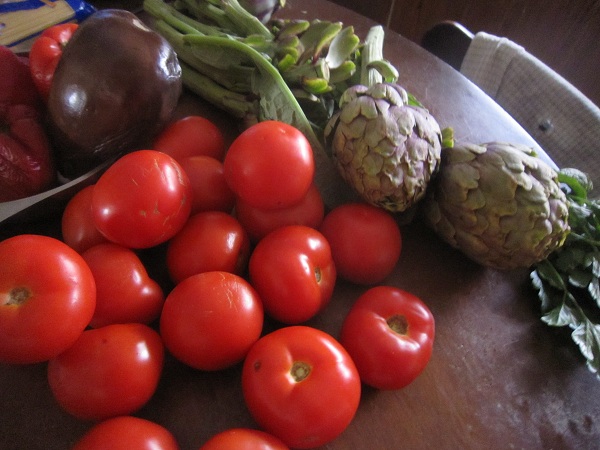
Tomatoes and other vegetables

I am told to cut the vegetables. I stupidly ask how she would like them. Diced? Quartered? The answer, you can probably guess, is however I like.

I start to brunoise the onion, the way I had been taught at cooking school.

Nonna looks over.

“What are you doing?”

“Chopping the onions like the chef taught me at school, nonna”

She stops what she’s doing to watch .

At that moment the nearly blunt knife doesn’t make a clean cut and the slippery onion falls from my fingers to the floor.

“Hmph,” says nonna. “I never went to school”

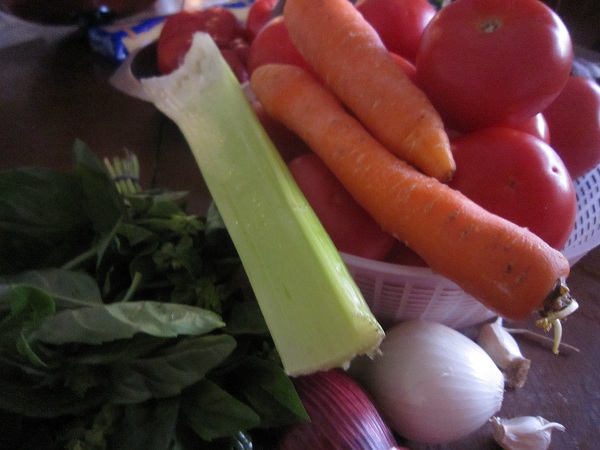
Ingredients for sauce

“What’s the sauce called Nonna?”

“Salsa Siciliana.”

“But it’s not very Siciliana.”

“Of course it is. I used to make it in Sicily so it’s Siciliana. But you can call it what you like…. salsa Abruzzese, salsa Napoletana, salsa Toscana….”

“What about salsa Australiana”

“Si, call it salsa Australiana, I like it.”

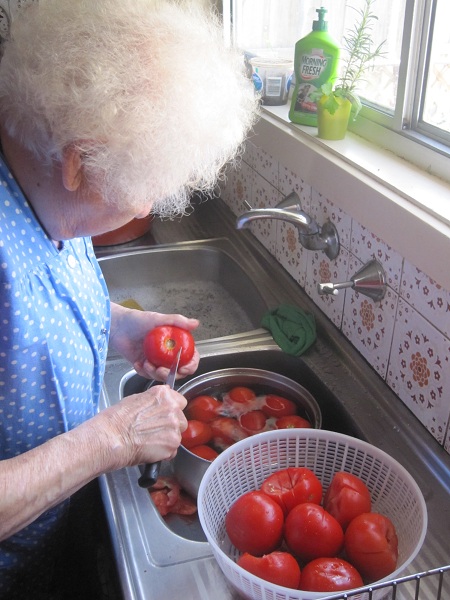
Nonna cutting tomatoes

Next to the eggplants preserved in oil and under a bottle of Magnesia San Pellegrino, I spy a jar of  Vegemite in nonna’s cupboard. I am shocked. I know of no Italian-born individual who can stomach the stuff. I decide to investigate.

“Nonna, do you eat Vegemite?”

“Yeah.”

“Really?”

“Oh no. It’s for (my second cousin) Tony. He ate it on toast every day for a year  but then he stopped. He doesn’t come much anymore,” she sighs.

“Do you want it? Take it, take it, ” she urges.

“No, no, so you’ve never, ever tasted it?”

“No,” she says resolutely.

A few minutes pass and we chop in silence.

She pauses for a minute.

“Is it good?”

“The Vegemite?”

“Yes”

“No not really”

“Oh, ok, it’s good I don’t eat it then huh?”

Vegemite in an Italian cupboard

Zio Sam,  nonna’s brother, comes home. Noticing the tomatoes we are cooking, he tells me at the grocer where he works they cost $5 a kilo. Hydroponics $10.

“Is that cheap or expensive, “ I ask ignorantly.

“Expensive! $2.99 or $3.65 not $5. They musta been scare, very scare.”

I guess he means scarce but the price is sort of scary, when you think about it.

Nonna cutting tomatoes

Nonna takes a break from cooking to check on her faithful companion, Fifi the dog.

“Why haven’t you eaten your pasta Fifi? Whatsamatter? Do you think we’re Americans here? Is that what you think?”

Fifi drops her head and continues to ignore Nonna.

“No respect,” says nonna exasperated “But what can you do?”

Nonna’s fresh tomato sauce

Serves about 15 people

  • 18 ripe tomatoes
  • 1 stalk of celery, peeled and roughly chopped
  • 2 small carrots,  peeled and roughly chopped
  • 1 small red onion, peeled and chopped
  • 1 small white onion, peeled and chopped
  • 2 garlic cloves, peeled and crushed
  • A few basil leaves
  • Pinch of bicarbonate of soda
  • Olive oil
  • Salt
  1. Wash the tomatoes and cut out the core. Score them with a deep cross. Place in a large saucepan.
  2. Over the tomatoes pour a generous amount of olive oil and a sprinkling of salt.
  3. Add celery, carrots, onions, garlic, basil and bicab. Turn the heat to medium-low and allow to cook, stirring occasionally, until the tomatoes have completely broken down.
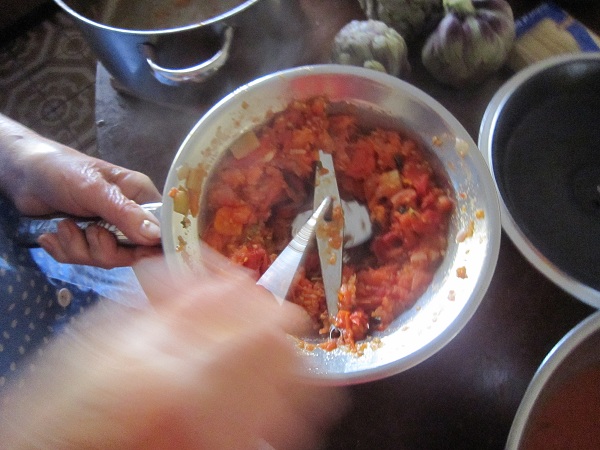
  4. Pass through a mouli and discard the solids. Serve immediately with pasta or bottle to put in the freezer.
Tomatoes with other ingredients in the pot
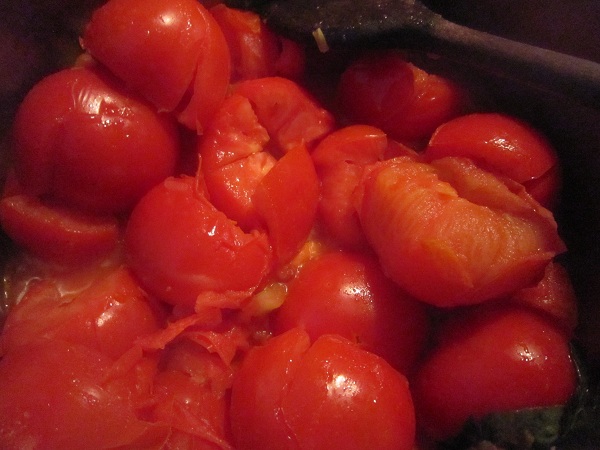
Tomatoes cooking
Tomato sauce cooking
mouli
Nonna with mouli and finished sauce

The macaroni cure

18 Jul
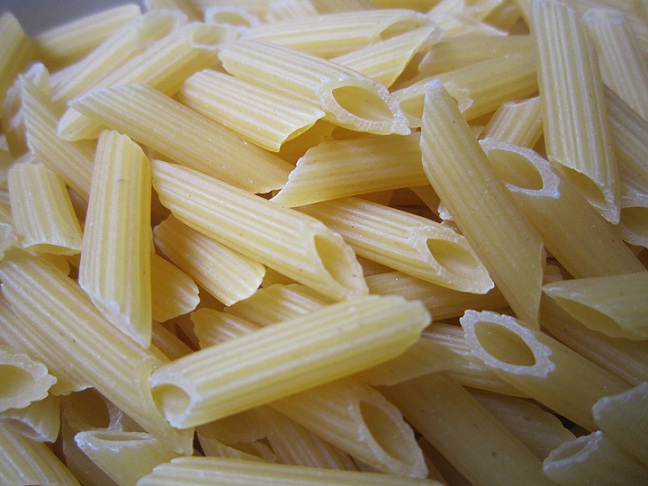
Uncooked penne

Good news for the wine and pasta set... if your definition of "news" doesn't mean it has to be new...

As a pasta addict from way back, I hate people who say it’s bad for you. All those Dukan, Atkins and anti-carb crusaders who maintain it’s too processed and too white to be beneficial. Oh, they say, you can have a little bit, but not after 5pm, and make sure you have it with loads of vegetables, and while you’re at it, wholemeal has more fibre so use brown instead of white. And skip the cheese. And add tofu. And really, you shouldn’t eat it at all, so, while you’re at it, just leave out the pasta altogether. You won’t miss it. Trust me. And you’ll feel so much better!

Hmpf. Makes me want to hotfoot it to my nonna’s house who understands there is only one real serving size when it comes to pasta – huge – and only one way to eat it – with plenty of rich ragu and a hilltop of freshly grated parmesan.

So I was happy to read that Charles Napier doesn’t agree with the pasta puritans.

The English scientist maintains that macaroni is actually an excellent cure for alcoholism. He says that macaroni, and other products made from flour,  as well as dried peas and lentils, work by rendering the “carbon in an alcoholic drink both unnecessary and repulsive”.

He cites the case of one 60-year-old man who “was seriously impaired by his frequent excesses”. After an “almost fatal attack of delirium”, the man adopted a diet heavy on the macaroni and beans, and, somewhat miraculously, “a complete cure was effected in seven months”.

Sure, he said this in 1878, but good science is forever right?

Maybe not, but at least the Pastafarians will be pleased …

Bibliography

  • “Alcoholism and Farinaceous Food.” The Sydney Morning Herald, 20 July, 1878, 7.

Spaghetti sandwiches

7 Jul
Spaghetti sandwich illustration

Spag sanga anyone? Lorraine Hannay's illustration of a spaghetti sandwich in Richard Beckett's Convicted Tastes.

I have a confession to make. I have never eaten a spaghetti sandwich. A tangle of tomato-tinged, soggy and sweet can-confined spaghetti has not ever presented itself to me as a viable sandwich filling. The concept is utterly foreign, which isn’t surprising given I grew up in a household where  a can of spaghetti was like bacon to a Jewish Rabbi – not only a banned substance, but one thought of with a fair amount of  disgust.

Not so for my eighth generation Australian husband who recalls with delight chomping down on buttered white bread crammed with slimy spaghetti.

He wasn’t the only one. Richard Beckett recalls that spaghetti sandwiches were once very much a part of the culinary landscape:

Its construction was quite basic – a spoonful of tinned spaghetti between two pieces of buttered bread. Along with baked beans, it was always an integral part of a plate of mixed sandwiches at city tearooms – now vanished – run by large department stores on their top storeys.

When exactly the spaghetti sandwich made its debut is hard to know. What we do know is that to make this historic sandwich you need a can of spaghetti, and that process was kicked off in the late 19th Century by the Franco-American company in the US.  By the 1920s it was joined by versions from Heinz and Campbells, amongst others.

Heinz, which didn’t start local production till 1934, claims that US miners introduced their canned products to Australia during the gold rush, along with their shovels and picks and dreams of striking it rich too, no doubt.

However, by 1917, you didn’t need to know an American miner to get your hands on a can of spaghetti – you would’ve found it along with other imported products like baked beans, cream of tomato soup and “many other desirable lines of distinctive quality” at HG Wilson and Co, “The Family Grocer” on Swanston Street in Melbourne, just opposite St Paul’s Cathedral.

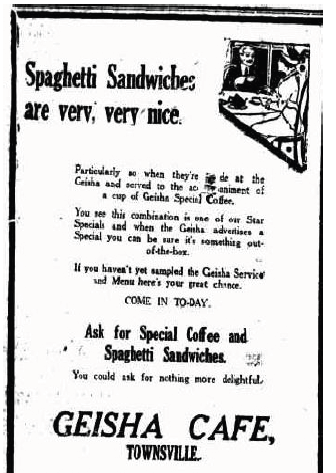
By 1924, the spaghetti sandwich must’ve been sufficiently established as a culinary entity as to allow the Geisha Café in Townsville to advertise it as “very, very nice”.  It might sound like they employed Borat to do their copywriting, but the Geisha was keen on selling its special  spaghetti sandwich with its “special coffee”, as, well, a “special”:

Spaghetti sandwich ad 1917

"You could ask for nothing more delightful" than a spaghetti sandwich, according to Cafe Geisha's ad in The Townsville Daily Bulletin,10 September 1924.

In 1935, the Barrier Miner of Broken Hill published Miss Marojorie Mann’s recipe for Hot Savory Spaghetti Sandwiches. It was sent in as an entry for an “Afternoon Tea Delicacies” competition. It didn’t win:

Hot Savory Spaghetti Sandwiches

Slices of crisp toast, well buttered, some thin slices of ham, sliced tomato, grated cheese (if desired), 1 tin spaghetti, parsley

Reheat the spaghetti thoroughly. Heat the ham in a little milk – either in the oven or over the fire. Place a thick layer of spaghetti on a piece of toast. Cover with another slice on this. Place heated ham and sliced tomato and cover with another slice of buttered- toast. Garnish with a sprig of parsley and sprinkle thickly with grated cheese. Serve very  hot.

Which begs the question, am I game enough to try this so-called “delicacy”? I think it’s time to confront my fears about this most foreign of foods,  and while I’ve barely recovered from my last spaghetti-led carb overload, I think, as they once said about Whitlam, it’s time…

Bibliography

  • Beckett, Richard, Convicted Tastes: food in Australia. Sydney : George Allen & Unwin, 1984, 204
  • Levenstein, Harvey. “The American response to Italian food, 1880 – 1930” in Food in the USA, ed: Counihan, Carole, M, Routledge, 2002, New York, 78.
  • “Groceries.” The Argus, 23 May 1917, 12.
  • “Spaghetti Sandwiches are Very, Very Nice.” Townsville Daily Bulletin, 10 September 1924, 3.
  • “Afternoon Tea Delicacies.” Barrier Miner, 14 September 1935, 4 

English breakfast

25 Mar
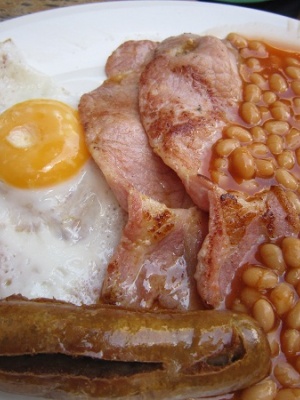
English breakfast

English breakfast in London circa June 2010. Is it that different from what Isabella Beeton is proposing?

Never know what to serve for breakfast? Think cereal is ok? Maybe toast and jam? Isabella Beeton, that 19h century doyenne of all things cooking, would think you were a jelly short of a proper luncheon. Here’s what she recommends for the “comfortable meal called breakfast”:

Broiled fish, such as mackerel, whiting, herrings, dried haddocks, &c.; mutton chops and rump-steaks, broiled sheep’s kidneys, kidneys à la maître d’hôtel, sausages, plain rashers of bacon, bacon and poached eggs, ham and poached eggs, omelets, plain boiled eggs, oeufs-au-plat, poached eggs on toast, muffins, toast, marmalade, butter, &c. &c.

I wonder if it’s low GI…

Btw if you have any interest in Mrs Beeton at all, and even if you don’t, be sure to read Kathryn Hughes’ biography – once you’ve read it, you’ll never think of Isabella in the same way again.

Australian ricotta – Part 2

9 Mar
Dairy Board Ad

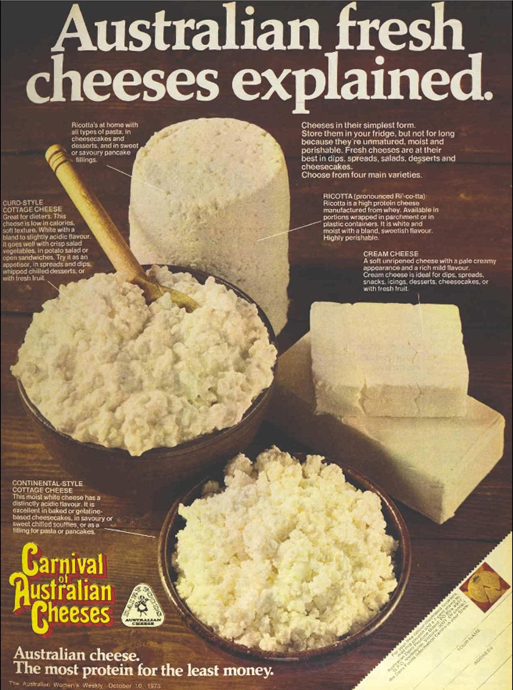
It's a carnival of Australian cheese and ricotta is well and truly on the float. From The Australian Women's Weekly 10 October 1973.

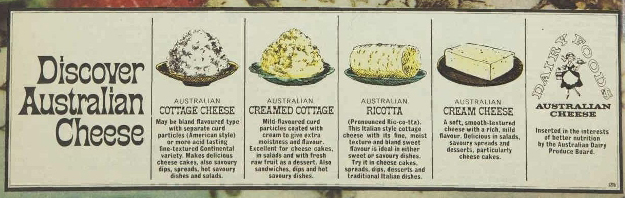
The 1970s open for ricotta with still more advertising from the Australian Dairy Board who are seemingly obsessed not only with making sure that we know it is “Australian Cheese. The most protein for the least money”, but also how on earth to pronounce it. Say after me everyone: ri-co-tta. Now that wasn’t so hard was it?

Perhaps it’s understandable that the ADB was keen for us to have a firm understanding of what ricotta was, because in the 70s and 80s, the cheese suffered from a bad case of SMD – schizophrenic media disorder – especially in The Australian Women’s Weekly.

First it was bad for our heart. In a 1975 article entitled A Doctor’s Advice on How to Avoid a Heart Attack, Dr Irving Levitas, the man who made sure smoking was never the same according to the author of the article, makes it clear ricotta is bad news:

There are a number of cheeses made with skim milk, including mozzarella and a Norwegian cheese called Jarlsberg. You don’t have to stop serving lasagna, for instance; just substitute skim-milk mozzarella and leave out the ricotta cheese.

 In 1977, however, the Australian Dairy Board (those guys again), made us an offer we couldn’t refuse:

 We promise to keep your food interest high, your calorie intake low with these tasty and delicious Dairy ideas.

 Ricotta was part of the promise and the ad suggests eating ricotta as a dip or mixed in with fruits like strawberries, pears, pineapples or melons.

Diet Dairy Foods

Dairy dieting with ricotta. From The Australian Women's Weekly, 7 December 1977.

Ricotta’s status as a diet friendly food seems to explode from this point onwards. If you wanted to follow the diet plan in How to be Forever Thin in 1976 you could have “1 medium size serving of ricotta or cottage cheese”.

In a 1981 Weight Watchers article trumpeting foods which were “off the banned list and on the programme”, you were allowed 1/3 cup ricotta cheese with a ½ cup of  grapefruit segments, a slice of toast, a teaspoon of margarine and a beverage for breakfast on Day 6.

While ricotta was firmly entrenched by the early eighties as the dieter’s friend, we also see it feature in several fatty friendly forms – the ricotta cake, pastry and slice – hence the schizophrenia.

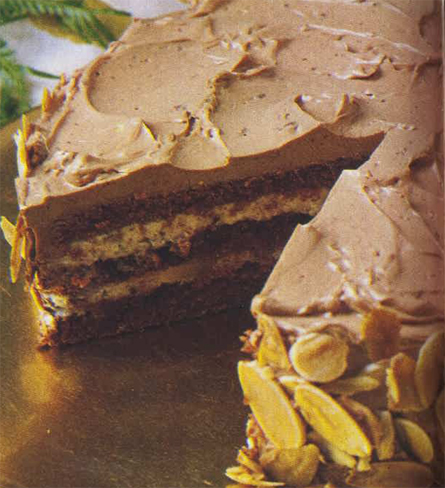
In 1977, Mrs C.L Angelico of North Ringwood, Victoria won $15 for her “not too sweet” Italian ricotta cake. It was quite different from the 1979 Italian ricotta cake recipe in an “All Occasion Cakes” feature which called for packet chocolate cake mix and lashings of Grand Marnier. 

Italian ricotta cake made from a chocolate cake packet mix... just like in Italy! From The Australian Women's Weekly, 1 August 1979.

In 1978, it’s Miss J Kaufler of Haberfield, NSW’s turn to claim the $15 prize for “a rich, buttery pastry (which) holds an unusual filling of ricotta cheese, cherries and nuts.”

The lesson out of all of this? Ricotta will make you lose weight. Unless you add a bucket of flour, sugar, eggs, milk and chocolate. Then it won’t. Really, I should’ve been a nutritional scientist with deductions like that…

There might be a part 3 in the next few weeks to bring ricotta up to the present day, but if you missed the first sizzling instalment, be sure to check out Australian ricotta – Part 1.

“Australian Fresh Cheeses Explained,” The Australian Women’s Weekly, 10 October 1973, 45.
Guinness, Daphne, “A Doctor’s Advice on How to Avoid a Heart Attack.” The Australian Women’s Weekly, 20 August 1975, 18-19.
“Low calorie, high interest (it’s dairy dieting).” The Australian Women’s Weekly, 7 December 1977, 166.
“How to be forever thin.” The Australian Women’s Weekly, 6 October 1976,  25-26.
“Prize recipe.” The Australian Women’s Weekly, 15 June 1977, 87.
“Prize recipe.” The Australian Women’s Weekly, 5 April 1978, page 98.
“All Occasion Cakes,” The Australian Women’s Weekly, 1 August 1979, 86
“Weight Watchers Magazine Supplement.” The Australian Women’s Weekly, 10 June 1981, 2, 3, 4, 6, 7, 9, 10.

Oh to be a fatso!

4 Mar
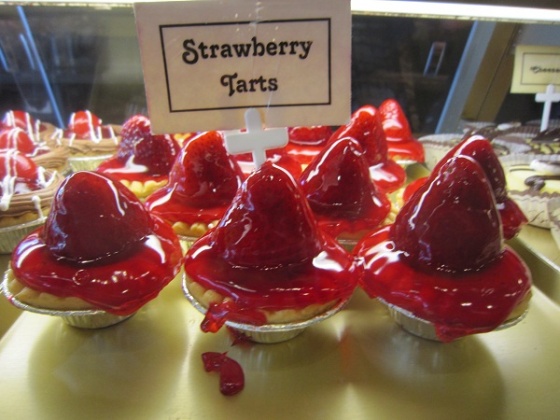
Strawberry tarts

Yes, I can eat those! These tarts would be approved on Brillat-Savarin's diet plan.

Every thin woman wants to grow plump: That is an avowal which has been made to us a thousand times.

Maybe in 1825 when you wrote that lovely line Jean Anthelme Brillat-Savarin, but not anymore. And I am one of them. I want to be thin too. Or at least thinner. And so, in the name of thinness, over the last three weeks, I have denied myself all the things that make life good – cheese, bread, pasta, deep fried bounty bars…

But Brillat-Savarin, the much acknowledged granddaddy of gastronomy, would’ve thought me a twit of the highest order. Here’s the diet he prescribed for all those thin ladies who wished to “fill out their curves”:

GENERAL RULE. Much fresh bread will be eaten during the day, and particular care will be taken not to throw away the crumbs. Before eight in the morning, soup au pain or aux pates will be taken, and afterwards a cup of good chocolate.

At eleven o’clock, breakfast on fresh broiled eggs, petit pates, cotelettes, and what you please; have eggs, coffee will do no harm.

Dinner hour should be so arranged that one should have thoroughly digested before the time comes to sit down at the table. The eating of one meal before another is digested, is an abuse.

After dinner there should be some exercise; men as much as they can; women should go into the Tuilleries, or as they say in America, go shopping. We are satisfied that the little gossip and conversation they maintain is very healthful.

At times, all should take as much soup, potage, fish, etc., and also meat cooked with rice and macaronies, pastry, creams, etc.

At dessert such persons should eat Savoy biscuits, and other things made up of eggs, fecula, and sugar.

And then this, my favourite line:

This regimen, though apparently circumscribed, is yet susceptible of great variety.

I think I could manage a diet where the variety involved eating lots of fresh bread, noodle soup, hot chocolate, eggs, chops, meat with rice, macaroni, pastry and cakes made with eggs, flour and sugar, not to mention a punishing exercise schedule of shopping and gossiping. It sure beats no carbs, that’s for sure.

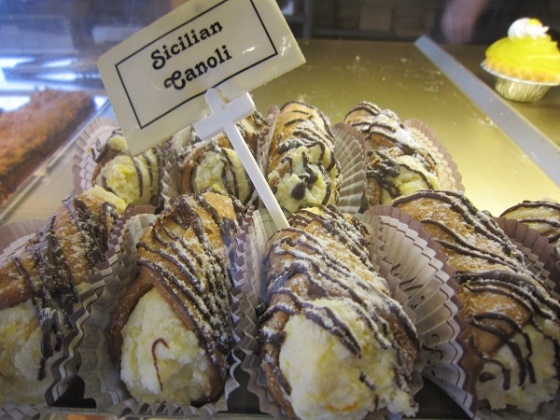
Sicilian canoli

No need to say to canoli on the Brillat-Savarin diet.

Brillat-Savarin, Jean Anthelme.  The physiology of taste, or, transcendental gastronomy [electronic resource] translated from the last Paris edition by Fayette Robinson, http://ebooks.adelaide.edu.au/b/brillat/savarin/b85p/.

Australian ricotta – Part 1

25 Feb

Some people understand the cost of living by the price of bread or milk or McDonald’s hamburgers. For me, it’s ricotta. A staple in my kitchen, I could not live without the stuff. Fresh, soft and still warm, I cannot resist scooping a few teaspoonfuls out of the container while I’m putting away the shopping. Days later, I’ll eat it with jam or honey on toast, with spinach in a pie, on spaghetti with eggplant and tomato, or stirred through pasta, made into a sauce with a bit of hot water, a handful of parmesan, a grating of nutmeg and a sprinkle of pepper. Comfort food at its best.

 But back to the index. When I lived in Leichhardt, in Sydney’s inner west, I used to buy ricotta for around $7.99 a kilo.

Later, when married life saw me move to the food wasteland that is Maroubra Beach, I had to make the admittedly-short journey to Maroubra Junction where I paid a shocking $10.99 a kilo.

Still, I realised I was better off than the poor ricotta-ripped off in Manly who were paying $15.99 a kilo. As for David Jones, in the city, they were suffering and continue to suffer similar stupid prices for a product that is not even a cheese – rather it’s a by-product of it.

In Melbourne, my home town, at the much loved Footscray Market, you can get it for $4.99 a kilo. And that, right there, is why I’m moving back to Melbourne.

All of this, however, got me thinking about when this most versatile of dairy products made its debut in the great brown land of Australia.

 The first mention of it I have found is in Tasmania’s daily newspaper, The Mercury, in 1930. In a short account of Christmas in Rome, the author describes the meal on Christmas Day as starting with soup:

…in which there are “cappelletti”, little cases of macaroni in the shape of hats, which contain a mixture of meat, brains, and “ricotta”, a kind of cream cheese.

It’s not till 1943 that there’s evidence of my favourite whey-based product for sale. The Cairns Post features an ad for Brightways Grocery where I would’ve been able to pick up 2 pounds of ricotta for sixpence. I’m not sure where that would sit on the index today, but what is surprising is that ricotta sits amongst the not-very-Italian ingredients of gooseberry jam, beetroot and the mysterious-sounding luncheon beef.

Perhaps the reason this ad wasn’t more targeted at the small Italian population of North Queensland was because many Italians there had either just been released from internment following Italy’s surrender to the Allies, or they were still incarcerated. Either way, anti-Italian sentiment in Queensland was running high.

 By 1954, however, back in Tasmania, it’s all about the Italians. A classified ad in The Mercury reads:

AAAAAA. TELL YOUR ITALIAN FRIENDS we have now BACCALA, Coppa, Bologna, Salame, Ricotta, Olio, Polenta. THE PANTRY, 37 Elizabeth St.

In the 1960s, ricotta became an ingredient that was featured in the odd Australian Women’s Weekly recipe, usually with the caveat that it could be substituted with either cottage cheese or cream cheese.

Publication in the Weekly generally means you’ve made it into the mainstream but in 1966, the Australian Dairy Produce Board thought the public still needed to be educated about the cheese and, maybe more importantly, where it’s from. An ad for “Australian ricotta” went something like this:

Ricotta ad

This ad appeared below an advertorial recipe for Heavenly Cheese Cake, which featured creamed cottage cheese, on 28 December 1966 in the Australian Women's Weekly.

The preoccupation with making sure the public understood that ricotta was now Australian continued into the late 60s. In a 1968 cookbook add-on about cheese again in the Australian Women’s Weekly, ricotta is one of many cheeses featured. Its provenance is given as “Italy” and we are told it cost “about 50 to 60 cents per lb”, however we are also told that it was one of many cheeses that used to be imported but was now made in Australia.

I find it quite hard to believe ricotta was ever imported, as it’s a fresh and highly perishable cheese. But if the bible of Australian womanhood says it is so, then it must be so:

cheeses of the world

Ricotta cheese is in the top left corner behind the glass of cottage cheese in this editorial spread from The Cheese Cook Book, an add-on to the Australian Women's Weekly on October 9,1968.

This brings us up to the 1970s which brought us flares, punk rock and a constitutional crisis. But you’ll have to wait for Part 2 to find out what happens next in ricotta’s journey from a cheese for the eye-talians to a common ingredient many of us eat and cook with all the time. Bet you can’t wait, right?

“Christmas at Rome.” The Mercury,5  February,1930, 4.
“Brightways Cairns.” Cairns Post, 30 September, 1943, 2.
“AAAAAA. TELL YOUR ITALIAN FRIENDS.” The Mercury, 14 January 1954,19. 
“Heavenly Cheese Cake.” The Australian Women’s Weekly, 28 December 1966, 6.
“Cheese adds that gourmet touch.” in The Cheese Cook Book in The Australian Women’s Weekly, October 9, 1968, p 2-15.

Dago tucker

21 Feb
Pasta

Aussie diggers wanted mutton over this...

In 1941, here’s how The Mail in South Australia saw Italian food and, as an extension of that, Italians themselves:

Dago Tucker

Australian troops in Libya have been solving the mysteries of Italian cuisine, and making queer dishes of Parmesan cheese, spaghetti, tomato extract, and olive oil from captured enemy stores. Because of water shortage, a soldier was seen bathing in Italian mineral water. —Cable.

In Libya da Aussies still pusha ahead,
Dey play a so well in da ruck,
Dey racea da transport like fasta da ped’
So turn to da Itala tuck’.
Spa water dey usea to hava da wash,
Da soap mixa up wid da fizz,
But somea dem maka da faces, by gosh,
When come to da catering biz.
Dey try on da tummy such queera da dish,
For mum’s kinda cooking dey certainly wish.

Dey gobble up yardsa da finest spaghett’,
When food in da dixie dey boil,
But people afraida dat some of dem get
Too mucha da oliva oil.
It might make ’em slippy, like Itala chaps,
If plenta da loota dey seize,
And breatha da digger it smella, perhaps,
Too mucha of Parmesan cheese,
Dey chew up da menus of Naples or Rome,
Bat rather have grub from da kitchen at home.
ANTONIO DI SEEBEE

In 2009, The Age reported the results of the BIS Shrapnel report Fast Food in Australia:

Italian was the most preferred cuisine in Victoria and South Australia. Thai food was No. 1 in NSW. For all other states and territories, Chinese was either top or equal top. Australian, English or traditional food came in fifth at 13 per cent, after Indian, Sri Lankan or Pakistani food at 17 per cent.

It did take 68 years, a World War and an immigration boom, but Australians these days, in the words of  eloquent poet Antonio di Seebee, no longer “rather have grub from da kitchen at home”.

“Dago Tucker.” The Mail, 8 February, 1941, 7.
Cauchi,
Stephen, “Italian fare to the fore in time of fiscal crisis.” The Age,  April 26, 2009, 13.

What to do when you run out of milk

18 Feb

Don’t have any milk for your morning coffee or tea? Mrs Isabella Beeton, in her classic 1861 Book of Household Management, solves the problem easily and, in her opinion, excellently:

An excellent substitute for milk or cream in tea or coffee

1815. Ingredients. – Allow 1 new-laid egg to every large breakfast-cupful of tea or coffee.

Mode. – Beat up the whole of the egg in a basin, put it into a cup (or a portion of it, if the cup be small), and pour over it the tea or coffee very hot. These should be added very gradually, and stirred all the time, to prevent the egg from curdling. In point of nourishment,  both these beverages are much improved by this addition.

Sufficient – Allow 1 egg to every large breakfast-cupful of tea or coffee.

Call me crazy, but I never thought to have my morning egg in my morning coffee.